

Preventing Bathroom Falls: A Caregiver's Safety Guide
Table of Contents
- Why Bathrooms Are the Most Dangerous Room for Falls
- Start With a Home Safety Assessment for Seniors
- Essential Bathroom Safety Equipment for Seniors
- Step-by-Step: How to Install Grab Bars Safely
- Simple Daily Habits That Reduce Fall Risk
- When DIY Isn't Enough: Professional Help and Beyond
- Conclusion: Small Changes, Lasting Peace of Mind
- Frequently Asked Questions
Last Updated: September 7, 2026
Why Bathrooms Are the Most Dangerous Room for Falls
The bathroom combines everything that makes a fall likely: hard, wet surfaces, limited space, and the need to stand, sit, and transfer between positions. For an older adult with balance issues or reduced strength, even a routine trip to the toilet carries real risk. Preventing bathroom falls for elderly parents starts with understanding the threat, then taking practical steps to reduce it.
Falls remain a leading cause of injury among older adults, and the bathroom is where many happen. Water, tile, and tight quarters mean there is rarely anything soft to break a fall, and little room to recover balance. A fall that might cause a bruise elsewhere can lead to a fracture or hospital stay here.
Most bathroom falls are preventable with the right equipment, habits, and home modifications. Below, we walk through a complete approach to bathroom safety.
Start With a Home Safety Assessment for Seniors
A home safety assessment for seniors is the foundation of any fall prevention plan. This is a room-by-room review of hazards and risks, done with your parent's specific needs in mind. You can perform one yourself in an afternoon.
Begin by looking at the bathroom from your parent's perspective. Consider their mobility level, whether they use a walker or cane, how steady they are when standing from a seated position, and how well they see in dim light. The CDC's fall prevention guidance emphasizes that a combination of personal risk factors and environmental hazards contributes to most falls, which means addressing both is essential.
Work through the room systematically. Check for loose rugs or mats, look at how easy it is to reach the toilet, sink, and shower, test the lighting for nighttime trips, and note whether there is anything stable to hold onto. Write down every concern, then prioritize.
One of the most valuable assessment tools is watching how your parent moves through the bathroom. Notice where they reach for support and find nothing, where they hesitate, and where they seem unsteady. These observations guide equipment choices better than any checklist.
Essential Bathroom Safety Equipment for Seniors
Bathroom safety equipment for seniors falls into a few core categories, each addressing a specific risk. You do not need everything on the market, but the right pieces can dramatically reduce fall risk.
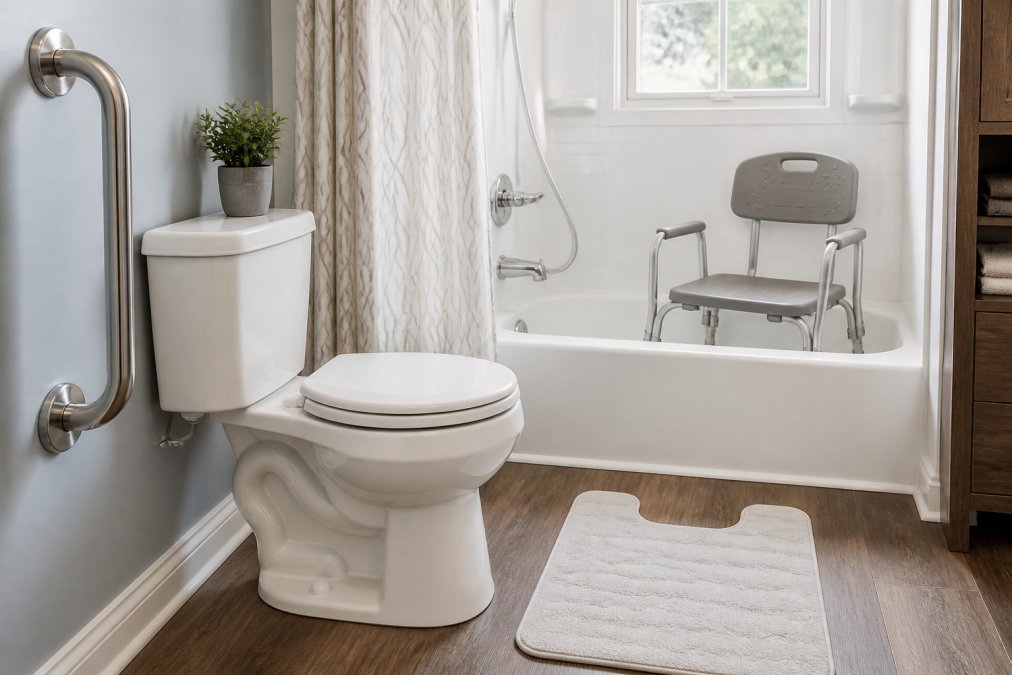
The most important rule is to choose equipment that matches your parent's needs and install it correctly. A grab bar that pulls out of the wall, or a bath mat that shifts underfoot, creates a new hazard. Start by identifying which category applies to your situation.
Grab Bars and Support Rails
Grab bars provide a secure handhold for sitting down, standing up, and steadying yourself on wet surfaces. They are the single most effective addition to most bathrooms, belonging near the toilet, inside the shower, and beside the tub.
For toilet support, a freestanding toilet safety rail is an excellent option. The AquaSense Toilet Support Rails support up to 300 pounds, adjust to fit most standard toilets, and require no wall mounting, making them ideal for rentals.

Raised Toilet Seats and Shower Chairs
A raised toilet seat reduces the distance a person must lower and lift themselves, addressing the most common cause of toilet-related falls. Models with removable arms add support for standing. The McKesson Raised Toilet Seat with Removable Arms adds 5 inches of height, while the AltiCare 5" Raised Toilet Seat with Adjustable Armrests offers a universal fit with fold-down arms.


Shower chairs and transfer benches let a person bathe while seated, eliminating the need to stand on a wet surface. A simple shower chair with non-slip feet works well for most seniors, while a transfer bench suits those who struggle to step over the tub wall.
Non-Slip Flooring and Bath Mats
Wet floors are the most obvious hazard in any bathroom. Non-slip mats inside the tub or shower provide traction where it matters most, while absorbent mats outside catch drips and keep the floor dry.
Look for mats with strong suction cups that grip the tub surface firmly. The AquaSense Contoured Bath Mat uses more than 400 suction cups to stay in place and adds gentle massage zones that improve circulation.
Step-by-Step: How to Install Grab Bars Safely
Learning how to install grab bars safely is critical, because a bar that pulls loose is worse than no bar at all. The key is anchoring into a wall stud or using heavy-duty anchors rated for the load. Most grab bars support 250 to 300 pounds when properly installed.
Follow these steps for a secure installation:
- Locate the wall studs using a stud finder. Mark their positions with a pencil.
- Choose the bar height based on the user's needs. For toilet support, the bar should be roughly level with the front of the toilet seat, within easy reach. For shower support, position it where the user naturally reaches when entering or exiting.
- Mark the mounting holes by holding the bar in position and tracing through the screw holes with a pencil.
- Drill pilot holes into the studs. If a stud is not available at the needed location, use heavy-duty toggle bolts rated for at least 300 pounds.
- Mount the bar with the provided screws, tightening firmly but avoiding over-torquing that could strip the threads.
- Test the bar by pulling downward and outward with your full body weight before allowing your parent to use it.
If you are not confident working with tools or your bathroom has unusual wall construction, professional installation is worth the cost. A handyman or occupational therapist can ensure the bars are positioned and anchored correctly.
Simple Daily Habits That Reduce Fall Risk
Beyond equipment, daily habits play a significant role in preventing bathroom falls for elderly parents. Many are simple adjustments that reduce risk without any installation.
Night lighting is one of the easiest wins. A small night light or motion-activated light in the bathroom and along the path to it helps seniors navigate safely during nighttime trips, when drowsiness and dim lighting combine dangerously. The National Institute on Aging's home safety checklist recommends keeping pathways well lit at all hours.
Encourage these habits with your parent:
- Sit on the edge of the bed for a moment before standing to use the bathroom at night, allowing blood pressure to adjust
- Use the grab bar or rail every time, not just when feeling unsteady
- Wipe up any water on the floor immediately, even small splashes
- Keep the bathroom floor clear of laundry, towels, and other items that create tripping hazards
- Use a handheld showerhead when seated, which allows bathing without standing or reaching
A handheld showerhead is a modest change with significant payoff. It lets a person bathe from a seated position, rinsing thoroughly without needing to stand or twist. Many families find this single upgrade makes showering safer and more comfortable.
When DIY Isn't Enough: Professional Help and Beyond
Knowing when to pick up a drill and when to pick up the phone is one of the most practical, and most overlooked, decisions in fall prevention. A clear-eyed assessment of your skills, your parent's needs, and the task at hand saves time, frustration, and potentially a serious injury.
The DIY Decision: A Simple Checklist
Before you commit to installing anything yourself, ask these three questions:
- Can you locate a wall stud with confidence? Grab bars are only as safe as their anchor. If you cannot find a stud and are unsure how to use a toggle bolt correctly, call a professional.
- Is the wall surface standard drywall or tile? Drilling into ceramic tile requires a diamond-tipped bit and a steady hand to avoid cracking. A single crack can compromise the waterproofing of the entire shower surround.
- Are you comfortable working with plumbing? Installing a handheld showerhead often involves unscrewing the existing shower arm. If the pipes are old or corroded, you risk a leak behind the wall. If you are not comfortable with the risk of a water-damage claim, consider professional help.
If you answered 'no' to any of these, the cost of a professional is a fraction of the cost of a fall-related emergency room visit or a water-damaged wall.
When a General Handyman Isn't the Right Choice
For simple grab bar installation, a skilled handyman is often sufficient. However, for more complex accessibility projects, you need a specialist. A general contractor may not be up to date on the specific clearances and load requirements for aging-in-place renovations.
Consider hiring an occupational therapist (OT) first. An OT can perform a detailed home safety assessment for seniors and recommend specific equipment based on your parent's exact physical abilities, not just their diagnosis. This is valuable when standard solutions have not fully addressed the problem. The OT's recommendations serve as a precise blueprint you can hand to a contractor.
For structural changes, look for a Certified Aging-in-Place Specialist (CAPS). This designation means the contractor has specific training in designing and building modifications that allow older adults to remain in their homes safely. A CAPS-certified professional understands curbless showers, offset drains, and proper grab bar blocking.
The Hidden Cost of 'Temporary' Solutions
A common pattern we see is families relying on temporary solutions for far too long while waiting to decide on a permanent fix. A freestanding toilet safety rail is a great tool, but it is not a substitute for a wall-mounted grab bar. A shower chair is essential, but it does not eliminate the risk of stepping over a high tub wall.
A Step-by-Step Plan for Hiring Help
If you decide to hire a professional, follow this process to ensure the job is done right:
- Get a referral. Ask your parent's primary care physician or a local hospital's social work department for names of occupational therapists or CAPS contractors they trust.
- Interview at least two candidates. Ask about their experience with older adults, their familiarity with ADA (Americans with Disabilities Act) guidelines, and whether they carry liability insurance.
- Ask for a written quote. The quote should specify the exact work to be done, the materials to be used, and the timeline for completion.
- Verify the specifics. Ask the contractor how they will anchor the grab bars. The answer should be 'into wall studs' or 'with heavy-duty toggle bolts rated for 300 pounds', not 'we'll use some strong anchors.'
- Do a final walkthrough. Before you pay the final invoice, test every grab bar by pulling down and outward with your full body weight. Check that the shower chair is stable and that the handheld showerhead reaches where it needs to without kinking.
The Maintenance Schedule Nobody Talks About
Once the professionals have left, the work is not over. A maintenance schedule for safety equipment is just as important as the initial installation. Grab bars should be checked monthly for looseness, a simple wiggle test can reveal a failing anchor. Suction mats need regular cleaning to maintain grip, as soap scum and hair can reduce their hold. Raised toilet seats and shower chairs should be inspected for cracks or wear. A quick monthly check takes minutes and ensures everything remains reliable.
Conclusion: Small Changes, Lasting Peace of Mind
Preventing bathroom falls for elderly parents does not require a complete home renovation or expensive professional services. In most cases, a thoughtful combination of equipment, habit changes, and small modifications makes the bathroom dramatically safer. The peace of mind that comes from knowing your parent can use the bathroom without fear is worth every minute spent.
Start with a home safety assessment for seniors, then add the equipment that addresses your parent's specific risks. Install grab bars properly or hire someone who can. Introduce the daily habits that reduce risk. And remember that you do not have to figure this out alone.
We understand the worry that comes with watching a parent navigate a bathroom that no longer feels safe. Our team, founded by experienced caregivers, curates reliable equipment to support independent living at home. Browse our bathroom safety collection to find the right solutions for your family, and take the first step toward a safer home today.
Frequently Asked Questions
What should I do if my elderly parent keeps falling?
Start with a home safety assessment for seniors to identify specific hazards. Focus on the bathroom first, as it has the highest fall risk. Install grab bars, add non-slip mats, and improve lighting. Talk to your parent's doctor about balance issues and review their medications. An occupational therapist can offer a professional home assessment and recommend the right bathroom safety equipment for seniors.
What is the best fall prevention device for seniors?
There is no single best device. The right choice depends on your parent's specific mobility challenges. For toilet transfers, a raised toilet seat with arms or toilet support rails are effective. For showering, a shower chair or transfer bench reduces strain. Grab bars near the toilet and shower are essential. A medical alert system provides peace of mind. Start with the equipment that addresses your parent's greatest difficulty.
How do I choose the right grab bars for my parent's bathroom?
Choose bars that anchor into wall studs or solid blocking, not suction-cup models for weight-bearing support. Look for textured, slip-resistant grips and a diameter of 1.25 to 1.5 inches for a comfortable hold. Ensure the bars can support at least 250 pounds. Place them where your parent actually needs support, such as beside the toilet and inside the shower. When learning how to install grab bars safely, always use proper anchors.
How often should I assess my parent's bathroom for safety hazards?
Perform a detailed home safety assessment for seniors at least every six months, or after any change in your parent's health, mobility, or medication. Walk through the bathroom and check for loose rugs, clutter, and the condition of non-slip mats. Test grab bars for stability and inspect equipment like shower chairs for wear. Quick monthly checks help you catch small issues before they become hazards.
Leave a comment