

What Are the 5 P's of Falls Prevention? A Caregiver Guide
Five Questions Before You Leave the Room
Pain, Potty, Positioning, Possessions, Pump. Five quick checks, asked every time you look in on your loved one. They help you catch the small, unmet needs that so often come before a fall.
Every year, more than 14 million Americans over 65 report a fall. That's one in four. Fewer than half of them tell their doctor. For the family member down the hall, that means listening for a thump at night and wondering what you missed. Most falls don't come out of nowhere, though. They start with a need nobody noticed in time.
Last Updated: October 20, 2026
What Are the 5 P's of Falls Prevention?
The 5 P's of falls prevention are Pain, Potty, Positioning, Possessions, and Pump. They form a rounding checklist that caregivers use to catch unmet needs before they turn into a fall. We think of them less as a memorized list and more as a set of questions you ask every single time you check on someone.
Why does a simple checklist matter so much? Because falls rarely happen out of nowhere. They usually trace back to something that was already wrong: a full bladder, a sore hip, a walker parked across the room. The 5 P's are a way of finding that "something" early.
Below, we'll walk through each P, explain how to use them in real rooms with real people, and show you how to build a fall risk assessment that actually fits your situation.
The 5 P's only work if you actually round on a schedule. A checklist you run once a day catches far less than one you run every hour or two.
Why Versions of the 5 P's Vary
You'll find slightly different versions of the 5 P's depending on where you look. Some list "Pain, Potty, Positioning, Possessions, Pumps." Others swap in "Periphery" for Possessions, or fold mobility and equipment into a broader "Pump" category. Some nursing guides add a sixth P for "Place."
That variation is not a sign that the framework is unreliable. It's a sign that the 5 P's are a memory aid, not a fixed clinical protocol.
Here's how we'd handle it. Pick one version, write it on a card, and use it consistently. Consistency matters more than which wording you choose.
One more thing worth saying plainly: the 5 P's are a prompt, not a diagnosis. They help you notice problems. They don't tell you what's causing a specific person's balance issues. For that, you need a proper fall risk assessment from a clinician.
1. Pain: Assess and Relieve Before They Move
Pain is the first P because it changes how people move. Someone with an aching hip or a sore knee will shift their weight, rush a transfer, or skip the walker entirely to avoid the discomfort. That's exactly when falls happen.
Ask directly, and don't accept "I'm fine" as a final answer. Many older adults underreport pain, especially when they worry about being a burden. Try specific questions instead: "Does anything hurt when you stand up?" or "How's the knee today, on a scale of one to ten?"
If pain is present, address it before you ask them to move. That might mean repositioning, offering prescribed pain relief on schedule, or simply waiting a few minutes. Pain relief is not a luxury in fall prevention. It's a safety step.
Do not rush a transfer because someone says they're in a hurry to use the bathroom. Hurried, painful movement is a common way home falls begin. Slow down and let the pain settle first.
2. Potty: Toileting Assistance on Every Round
Toileting is the P most closely tied to nighttime falls. A large share of home falls happen on the trip to the bathroom, often in the dark, often in a hurry.
of falls among hospitalized adults 60 and older were linked to toileting in one year-long study. In 80% of the nighttime toileting falls, the person was moving without the level of help their care plan called for.
Offer toileting assistance on every round, even if the person says they don't need it. "Do you need to use the bathroom before I go?" is a better question than waiting to be asked.
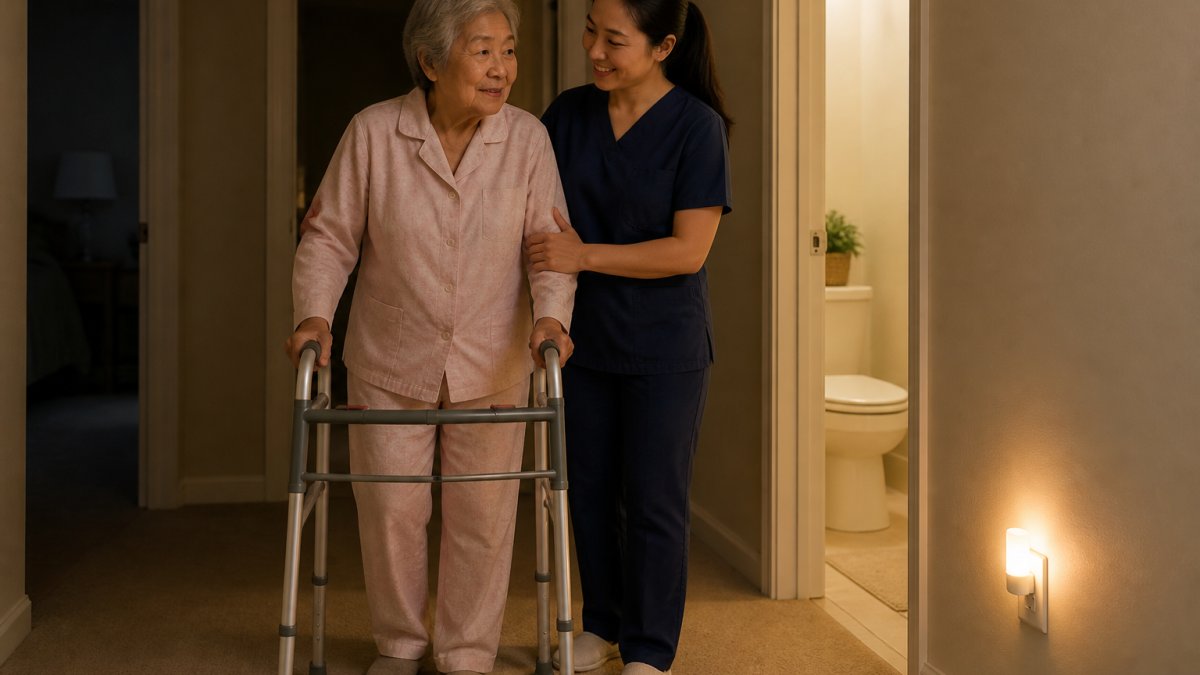
Make the trip itself easier. A clear path, nightlights along the route, and a raised toilet seat with armrests all reduce the effort of getting there and back. You can browse options like these in our toilet safety collection.
Light the Path Before Anyone Gets Up

The HealthSmart LED Compact Nightlight turns on by itself when the room gets dark and off again at daylight, so there's no switch to find at night. The 2-pack lets you put one by the bed and one along the hallway or in the bathroom.
View the Nightlights3. Positioning: Comfort, Alignment, and Skin Integrity
Positioning is about how the body is arranged, whether in bed or in a chair. Poor positioning causes discomfort, pressure on the skin, and the kind of restless shifting that leads someone to climb out of bed unassisted.
Check that the person is comfortable and properly aligned. In bed, that means the head is supported, hips and knees are at a natural angle, and no limb is pinned or dangling. In a chair, feet should rest flat on the floor or a footrest, with the back supported.
Skin integrity belongs here too. Redness or breakdown at pressure points is a signal to reposition more often. A bed assist handle can give someone a stable grip for repositioning themselves, which supports independence and reduces the urge to lunge for a nearby chair. Our bed safety accessories include handles and rails designed for home beds.
4. Possessions: Keep Personal Belongings Within Reach
Possessions means the things a person needs close by: glasses, phone, water, call bell, remote, medications, hearing aids. When those items are out of reach, people reach for them. Reaching from a bed or chair is a classic fall setup.
Before you leave the room, do a quick scan. Is the water within arm's length? Are the glasses on the nightstand, not the dresser? Is the phone charged and reachable? A simple bedside organizer pouch attached to a bed rail keeps these items together and off the floor.
Put the call bell or phone where the person can reach it without turning their body. If they have to twist or stretch to grab it, it's in the wrong spot.
Clear walkways belong to this P as well. Shoes, cords, rugs, and pet toys on the path to the bathroom are environmental hazards. Move them before they become a fall.
5. Pump: Mobility, Assistive Devices, and Medical Equipment
"Pump" covers the equipment that keeps a person moving safely: walkers, canes, wheelchairs, and any medical equipment like a pump or IV line that has to travel with them.
Check that assistive devices are within reach and in working order. Is the walker parked next to the bed, brakes locked, at the right height? Is the cane by the chair?
For anyone using a pump or line, route tubing so it doesn't catch on furniture or become a trip hazard. Keep the equipment's wheels or casters clear, and make sure the person knows how to move with it safely.
If mobility has changed recently, the device may need to change too. A rollator with a seat and large wheels handles thresholds and outdoor pavement better than a basic walker. Our rollators and walkers collection has options for different needs. A physical therapist can help you check the height and fit before you switch.
Fall Risk Assessment for Older Adults: Make the 5 P's Personal
A fall risk assessment is a structured review of the factors that make a specific person more likely to fall.
Start with the basics. Ask about previous falls, fear of falling, and any near misses. Review medications with a pharmacist or clinician, since some can affect balance or blood pressure. Check vision and hearing.
Then map the findings onto the 5 P's. If pain is the main issue, focus your rounds there. If nighttime toileting is the trigger, prioritize lighting and a clear path.
The CDC's STEADI initiative for fall prevention offers a clinician-facing framework for screening and assessment that many home care teams use as a reference.
Reassess regularly. A person's risk changes after an illness, a new medication, or a decline in mobility. What worked three months ago may not fit today.
Fall Prevention Tips for Caregivers: Rounding, Communication, and What to Do After a Near Miss
Rounding is the engine behind the 5 P's. Intentional rounding, sometimes called hourly rounding, means checking on the person on a set schedule rather than waiting for a call.
How often should you round? It depends on the person. Someone with frequent nighttime toileting needs may need a check every hour or two overnight. Someone more stable may need less.
Communication matters just as much. Explain what you're doing and why. Ask permission before helping with toileting or repositioning.
The 5 P's aren't a test you pass once. They're a promise you keep every time you walk into the room.
After a near miss, write down what happened while it's fresh: the time, what the person was trying to do, and what was out of place. Patterns show up fast, and patterns point to the fix.
What about after an actual fall? Check for injury before moving anyone, and call for medical help if there's pain, a head strike, or any sign of injury. Even without injury, treat the fall as a signal. Review the 5 P's for that person and ask what was missed. A bedside floor mat can soften the landing if a fall does happen, and a fall prevention alarm can alert you the moment someone tries to get up unassisted. Consider options like the Tri-Fold Bedside Floor Mat - High-Density Foam, Foldable or the Proactive Medical Protekt Fall Prevention Alarm Monitor.
A Heads-Up When They Start to Rise

The Protekt alarm works with a pressure pad or a pull-string clip and sounds when your loved one starts to leave the bed or chair, so you can get there to help. Advanced models add a short delay to cut down on false alarms from normal shifting. An alarm supports your awareness. It doesn't replace your rounds or your supervision.
View the AlarmHere's a quick summary of what each P covers and how often to check:
| P | What to Check | How Often | Common Fix |
|---|---|---|---|
| Pain | Discomfort before movement | Every round | Relieve pain, then move |
| Potty | Toileting needs | Every round | Offer assistance, light the path |
| Positioning | Comfort, alignment, skin | Every round and after repositioning | Adjust support, check pressure points |
| Possessions | Belongings within reach | Every round | Bedside organizer, clear walkways |
| Pump | Devices and equipment | Every round and after any change | Park devices close, route tubing safely |
We're caregivers first, and we've built our store around the practical things families actually need for safer days and nights at home. If you're not sure where to start, a nightlight, a grab bar, and a raised toilet seat help with many of the highest-risk moments.

Falls at home rarely come from one big mistake. They come from small unmet needs stacking up until someone tries to handle one alone. The 5 P's give you a way to find those needs before they do.
Frequently Asked Questions
What are the 5 P's of falls prevention?
The 5 P's are a rounding checklist caregivers use to catch unmet needs before they turn into a fall: Pain, Potty, Positioning, Possessions, and Pump. During each round you assess pain and offer relief, ask about toileting, check that the person is comfortably positioned with skin intact, make sure belongings and the call bell are within reach, and confirm mobility aids and any medical equipment are accessible and working. The list is a prompt, not a script, so adapt the wording to the person you care for.
How can caregivers use the 5 P's during daily routines?
Fold the 5 P's into the rounds you already make: before bedtime, at shift change, and every one to two hours if the person is at high fall risk. At each visit, work through the five prompts in a natural conversation rather than a checklist interview. Write down what you changed, such as a repositioned call bell or a fresh pain relief offer, so the next caregiver picks up where you left off. Consistent, unhurried rounds tend to surface problems earlier than waiting for a call bell.
Which version of the 5 P's should I follow?
Versions vary by facility and by training program, and some replace one P with another, such as placing 'personal needs' or 'prevention of falls' in the list. What matters is that your version covers the same ground: pain, toileting, positioning, belongings, and mobility or equipment. Pick one version, write it into your care plan, and use the same wording every round so family members and hired caregivers all know what to check.
How do the 5 P's fit into a fall risk assessment for older adults?
A fall risk assessment identifies which P's matter most for a specific person. If a clinician notes urgency with toileting, that P becomes the priority on every round. If pain limits standing, plan pain relief before transfers. Ask the person's doctor or an occupational therapist to review the assessment and translate it into a written care plan, then use the 5 P's as the daily tool that carries those findings into practice.
What should I do after a fall or near miss?
Check for injury first and call for medical help if there is pain, a head strike, or any change in alertness. Once the person is safe, write down what happened: the time, what they were trying to do, what was out of reach, and which P was missed. Review the near miss with the care team, adjust the care plan, and recheck the room for hazards such as clutter, poor lighting, or a loose rug. A near miss is useful information, so treat it as a reason to change something rather than a reason to restrict activity.
Shop Fall Prevention
Bedside fall mats, movement and exit alarms, floor sensors, and non-slip mats for the moments that matter most.
Shop NowFamily Caregiver Resources
Guidance, tools, and support from EnhDme to help you care with confidence and take a real break.
Explore Resources
For more than 25 years, Valerie has seen home care from every side of the front door. She built and led a home care agency, cared for her own parents, and has long championed older adults and the families who love them. Today she brings that hard-won perspective to EnhDme, helping caregivers find the equipment and supplies that make home a safer, gentler place to give and receive care.
Sources
Centers for Disease Control and Prevention (2026). Older Adult Falls Data.
Centers for Disease Control and Prevention (2026). Facts About Older Adult Falls.
National Safety Council. Older Adult Falls. Injury Facts, tabulations of National Center for Health Statistics data.
Rose G, Decalf V, Everaert K, Bower WF (2020). Toileting-related falls at night in hospitalised patients: The role of nocturia. Australasian Journal on Ageing, 39(1), e70–e76.
Centers for Disease Control and Prevention. STEADI: Older Adult Fall Prevention.
Leave a comment