

Bariatric Patient Lift Weight Capacity: A Complete Guide
The Number on the Box Is Only Half the Story
When your loved one needs a bariatric lift, the rated capacity is the first number you look at. But the sling, the doorways, the floors, and your own back all have limits too. This guide walks you through every one of them, so the lift you bring home actually works in your home.
In one hospital study, bariatric patients made up less than one in ten patients, yet nearly 30% of staff patient-handling injuries involved them. Those were trained nurses with a team behind them. At home, it is often just you. That's why the right lift, rated for the whole load and sized for your home, matters so much.
Last Updated: October 11, 2026
Understanding Bariatric Patient Lift Weight Capacity Requirements
Choosing the right bariatric patient lift weight capacity means the difference between a safe transfer and a dangerous situation. Finding equipment that matches both the patient's needs and your home's physical realities is essential.

A bariatric patient lift is designed for individuals with higher weight requirements, typically 600 to 1,000 pounds or more. The weight capacity is the maximum load the entire system can safely handle, from base frame to sling attachment points.
The rated capacity of a lift applies to the ENTIRE system working together. If any single component (sling, base, spreader bar, or attachment point) has a lower limit, that becomes your actual safe working capacity. Always check the manufacturer's specifications for every part of the lift, not just the headline number.
The right lift depends on the patient's current weight, anticipated changes, caregiver physical ability, and available space for transfers.
How to Choose a Patient Lift for Your Specific Needs
Selecting a patient lift requires looking at several practical factors beyond just weight capacity. The type of lift, manual versus powered, ceiling-mounted versus mobile, changes everything about how transfers work in your home and what capacity range you actually need.

Manual Lifts vs. Powered Lifts
Manual lifts rely on caregiver strength and are less expensive but demand significant physical effort. For bariatric transfers, they can strain caregivers, especially with repeated daily transfers.
Powered lifts use battery or electric motors, operated by hand pendant or button.
Powered lifts cost more and require charging, but most caregivers find the reduced strain and improved safety justify the investment for daily or frequent transfers.
Ceiling Lifts vs. Mobile Floor Lifts
Ceiling lifts are permanently installed on ceiling or wall tracks.
Mobile floor lifts roll on casters and move freely throughout the home with no installation needed.
EnhDme offers powered mobile lifts designed to roll through standard doorways while providing the stability bariatric transfers demand. Explore our collection to find the right capacity for your needs.
Bariatric Lift Sling Weight Limit and Compatibility
The sling is where patient and lift connect and is often overlooked in capacity calculations.
Bariatric slings come in different styles, full-body, sit-to-stand, and specialized designs, each with its own weight rating, typically 600 to 1,000 pounds.
Verify the sling is rated for the same capacity as the lift. Many make the mistake of pairing a heavy-duty base with a standard sling.
Your lift is only as strong as its weakest part, and that part is often the sling.
Slings wear out faster than lift bases. Check your sling regularly for tears, thin spots, or fraying. A damaged sling can fail suddenly under load, even if the lift base is in perfect condition. Replace slings immediately when you notice damage, don't wait until the next scheduled maintenance.
Bariatric Lift Doorway Clearance and Space Planning
A bariatric patient lift is only useful if it can move through your home and position safely at the patient's bed, chair, or toilet. Conduct a thorough spatial assessment before purchasing, many families discover their lift won't fit through hallways or turn into rooms. A few measurements prevent costly mistakes.
Doorway Width and Passage Routes
Most mobile bariatric lifts have a base width of 28 to 36 inches; standard doorways are 32 inches wide. Some fit with minimal clearance; others won't pass.
Measure every doorway the lift must pass through. Record bedroom, bathroom, hallway, and storage doorways.
If a doorway is narrower than 32 inches, check whether the frame can be widened.
Turning Radius and Hallway Maneuverability
A lift that barely fits through a doorway may not turn into rooms.
Measure hallway width and note corners. If your hallway is 36 inches with a tight corner, a 5-foot turning radius lift won't fit.
If your home has tight corridors, consider removing interior doors, consolidating transfers to one room, installing a ceiling lift, or using a narrower-base mobile lift.
Floor Surface and Stability
Bariatric lifts need stable flooring. Casters roll smoothly on hard, level surfaces like tile or vinyl.
Walk the transfer route and note floor conditions: Is the floor level? Are there thresholds (½-inch is manageable; 1-inch or higher is difficult)?
If the floor is uneven or has significant thresholds, install ramps or shims. Remove thick carpet from the transfer route or lay down a temporary hard-surface pathway.
Bed Clearance and Transfer Positioning
Measure space around the bed: How far is it from walls on each side? Can the lift base fit on both sides?
A bariatric lift base is typically 28-36 inches wide and 40-50 inches long. Small bedrooms or wall-positioned beds may allow approach from only one side, limiting transfer flexibility.
If space is tight, move the bed away from the wall, use a narrower frame, angle the bed, or use a sit-to-stand lift instead of a full mobile lift.
Bathroom Access and Toilet Positioning
Bathroom doorways are often the limiting factor, many are narrower than 32 inches, and toilet areas may lack space for a full-size lift base.
Measure your bathroom: doorway width (actual opening is often 1-2 inches narrower than frame), distance to toilet, space beside toilet (at least 12-18 inches for lift base), ceiling height, and floor condition.
Bathroom transfers often require a different approach than bed transfers. A sit-to-stand lift or grab bars may be safer and more practical for toilet transfers.
Bari+Max HD Electric Patient Lift 1000lb
When your loved one's weight, plus a safety margin, is more than a 600 lb lift can handle, a powered lift rated to 1,000 lb gives you room to work. Before you order, compare its base dimensions with the doorway, hallway, and bathroom measurements you just took, and pair it with a sling rated for the same load.
View the LiftStorage and Daily Access
Consider storage options: bedroom corner or closet, garage or utility room, under the bed, or a dedicated storage closet.
If storage is limited, consider a compact lift or ceiling-mounted model. Some families store lifts in a garage and roll them in for each transfer if mobility needs are predictable.
Creating a Floor Plan
Sketch a floor plan marking doorways, bed and chair positions, toilet, hallway width, obstacles, and storage. Trace the lift's footprint using dimensions from the manual. Can it fit through doorways and turn into rooms? Is there clearance around bed and toilet? This exercise reveals problems before purchase.
A lift with adequate weight capacity is only half the equation. Spatial planning determines whether the lift is actually usable in your home. Measure twice, buy once, and don't hesitate to consult with a physical therapist or occupational therapist if you're unsure whether a particular lift will work in your space.
Patient Lift Safety Checklist Before Each Transfer
Before each transfer, complete this safety check to reduce risk.
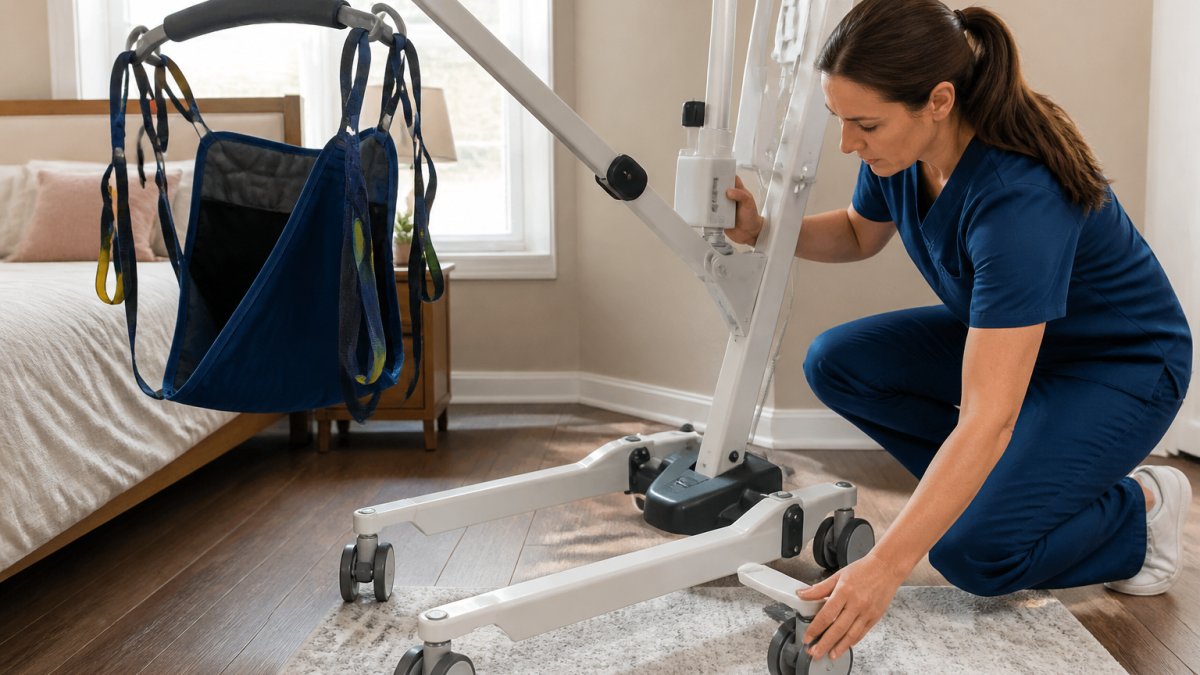
| Safety Check | What to Look For | Action if Problem Found |
|---|---|---|
| Sling condition | Tears, thin spots, fraying, stains | Do not use; replace sling immediately |
| Attachment points | All straps secure, no loose hardware | Tighten or repair before transfer |
| Base stability | Casters roll freely, brakes lock firmly | Replace damaged casters; test brakes |
| Hydraulic/electric function | Smooth raising/lowering, no jerking | Do not use; service equipment |
| Battery charge (powered lifts) | Full or near-full charge | Charge before transfer |
| Clear pathway | No obstacles, tripping hazards removed | Clear the route completely |
Position the lift directly under the patient with the base set as your lift's manual directs (some manufacturers say to leave the rear casters unlocked during the lift so it can settle under the load). Verify sling positioning and secure attachment points. Lower slowly and watch for unusual movement. Stop immediately if something feels wrong.
Most caregiver injuries happen during transfers that feel "routine." Never skip the safety checklist, even if you've done the same transfer a hundred times. One missed step can cause serious injury to you or the patient.
Calculating Capacity and Verifying Equipment Specifications
Manufacturers test lifts under controlled conditions with static load and ideal positioning. Real transfers involve movement and shifting weight. The rated capacity includes a safety margin, so calculate actual safe working capacity by checking every component, not just the headline number.
Step-by-Step Capacity Calculation
To determine the maximum safe weight for your specific lift and transfer situation, follow this process:
- Gather manufacturer documentation for lift base, sling, spreader bar, and accessories. Each component has its own rated capacity, write down every number.
- Identify the lowest-rated component. Your safe working capacity is the LOWEST number.
- Account for patient weight plus sling and accessories. Add sling weight (typically 5-15 pounds), positioning cushions, and medical devices.
- Apply a safety margin. Professional guidelines recommend operating at no more than 80% of rated capacity.
Patient 480 lbs + sling 12 lbs + aids 8 lbs = 500 lbs total. Lift rated 600 lbs. At 80%, that lift's working limit is 480 lbs. Because 500 lbs is over that limit, this situation calls for a higher-capacity lift, with a sling rated to match.
Dynamic Load and Transfer Conditions
The rated capacity assumes ideal conditions. Real transfers introduce additional forces:
-
Patient movement
Movement can spike load 10-20% above static weight.
-
Sling stretch
Stretch may cause momentary jerks that increase stress on attachment points.
-
Uneven weight distribution
Uneven weight concentrates load on fewer points, reducing safe capacity.
Verification Checklist
| Component | How to Verify | Red Flags |
|---|---|---|
| Sling rating label | Check tag sewn into sling; compare to lift documentation | Label missing, faded, or doesn't match lift capacity |
| Spreader bar | Look for stamped or embossed rating; check manual | No visible rating; manual doesn't list bar capacity |
| Attachment hardware | Inspect bolts, rivets, and connection points for damage | Loose bolts, cracked welds, bent attachment ears |
| Casters | Check for weight rating on wheel assembly or base frame | No rating visible; wheels cracked or severely worn |
| Lift base frame | Review manual for rated load; inspect frame for dents or cracks | Visible damage; frame twisted or misaligned |
| Maintenance records | Request service history from previous owner or facility | No records available; last service over 12 months ago |
If any component is missing a rating or shows damage, do not use the lift until repaired or replaced.
Documenting Capacity for Your Situation
Create a simple record: lift model and serial number, rated capacity of each component, actual safe working capacity, patient's current weight, last inspection date, and sling replacement date. Keep with documentation and share with care staff. Recalculate if weight or accessories change.
Safe Patient Handling and Caregiver Injury Prevention
Bariatric transfers are high-risk for caregiver injury.
A powered bariatric patient lift reduces injury risk by removing physical strain.
drop in resident-handling injury rates (workers' compensation claims) after nursing homes added mechanical lifts, a no-manual-lifting policy, and staff training. Your home isn't a nursing home, but the lesson carries over: let the equipment take the weight.
Safe handling requires proper technique: position close to patient, keep back straight, let the lift do the lifting.
Communicate with the patient: explain what you're doing, go slowly, and watch for discomfort or fear.
Take regular breaks, caregiver fatigue increases injury risk. Pace yourself and ask for help when needed.
Frequently Asked Questions
How do I choose the right weight capacity for a bariatric patient lift?
Select a bariatric patient lift with a rated load capacity at least 20-30% higher than the patient's current weight to account for dynamic loading and safety margins. For example, if a patient weighs 450 pounds, a 600 lb capacity lift provides a comfortable buffer. Consider future weight changes and the total system capacity, including the sling, spreader bar, and base. Always verify that every component meets or exceeds the required capacity, not just the lift frame alone.
What is the difference between a sit-to-stand lift and a full-body bariatric patient lift?
A sit-to-stand lift assists patients who can bear some weight and help with the transfer process by providing support as they rise from a chair or bed. A full-body lift suspends the patient completely and is used for patients with limited mobility or those unable to support any weight. Full-body lifts offer more flexibility for different transfer scenarios, including floor rescues after a fall. Choose based on the patient's mobility level and the types of transfers needed.
Does the sling have to match the lift's weight capacity?
Yes, the bariatric lift sling weight limit must meet or exceed the patient's weight and the lift's rated capacity. A sling rated for 600 pounds cannot safely support a patient on a 1,000 lb capacity lift if that patient weighs more than 600 pounds. Always verify the sling's rated load capacity on the manufacturer's label and confirm it matches your lift and patient weight. Mismatched components create a serious safety risk, even if the lift frame is rated higher.
What should I check on a bariatric patient lift before each transfer?
Before every transfer, inspect the lift base for stability and ensure all casters lock properly. Check that the sling is free of tears, stains, or damage and that all attachment points are secure. Verify the hydraulic or electric system operates smoothly without leaks or unusual sounds. Confirm the spreader bar moves freely and that all straps and connectors are intact. Test the hand pendant or controls to ensure they respond correctly. If you notice any damage or malfunction, do not use the lift and contact the equipment provider.
Can a bariatric patient lift fit through a standard doorway?
Most bariatric lifts have a base width of 24-36 inches when the legs are closed, which fits through standard 32-36 inch doorways with minimal clearance. However, bariatric lift doorway clearance depends on the specific model and how tightly the base closes. Measure your doorways before purchasing and compare them to the lift's closed base width. Some models feature offset bases or narrow-profile designs for tighter spaces. If doorways are narrower than 32 inches, confirm the lift model's specifications or consider a ceiling-mounted lift instead.
How often should a patient lift and sling be inspected?
Perform a visual inspection before every single transfer, checking for visible damage, proper function, and secure connections. Conduct a more thorough maintenance inspection at least monthly, testing all moving parts, checking for leaks, and verifying that the lift operates smoothly. Have a qualified technician perform a formal inspection annually or per the manufacturer's recommendations. Keep detailed records of all inspections and maintenance. Report any concerns immediately to avoid using equipment that may not be safe.
What happens if a patient's weight exceeds the available lift capacity?
If a patient's weight approaches or exceeds the lift's rated capacity, you need a higher-capacity model. Using a lift beyond its rated load capacity voids the warranty, increases the risk of equipment failure, and puts both the patient and caregiver in danger. Discuss weight changes with the patient's healthcare provider and explore higher-capacity options, such as 700 lb, 1,000 lb, or specialized bariatric equipment. EnhDme offers a range of heavy-duty lifts designed for patients with higher weight requirements.
Why is load distribution important in bariatric patient transfers?
Load distribution affects how the lift handles the patient's weight and how the sling supports them during transfer. A sling that does not distribute weight evenly can cause discomfort, restrict breathing, or create pressure points on the patient's body. The spreader bar and attachment points must be properly positioned so the patient's weight is balanced across the sling. Poor load distribution increases strain on the lift's components and raises the risk of equipment failure. Always use slings designed for bariatric patients and ensure proper positioning before lifting.
Shop Patient Lifts
Powered and bariatric lifts in a range of capacities, so you can match the lift to the whole load.
Shop NowFamily Caregiver Resources
Guidance, tools, and support from EnhDme to help you care safely and take a real break.
Explore ResourcesSources
Randall SB, et al. (2009). Expanded OSHA 300 log as metric for bariatric patient-handling staff injuries. Bariatric Nursing and Surgical Patient Care. Summarized in American Nurse: Prepare to care for patients of size.
Emmerich SD, et al. (2024). Obesity and Severe Obesity Prevalence in Adults: United States, August 2021–August 2023. NCHS Data Brief No. 508.
NIOSH. Safe Patient Handling and Mobility (on Waters TR, 2007, "When is it safe to manually lift a patient?").
AARP & National Alliance for Caregiving (2025). Caregiving in the US 2025: key findings; full report.
Collins J, Wolf L, Bell J, Evanoff B (2004). An evaluation of a "best practices" musculoskeletal injury prevention program in nursing homes. Injury Prevention, 10(4). Results as reported by NIOSH in EHS Today.
Leave a comment