

Expert Guidance for Elderly Home Care: A 2026 Guide
Table of Contents
- Building Your First 30-Day Care Plan
- How to Prevent Elderly Falls at Home
- Essential Home Safety Modifications for Seniors
- Daily Living Aids for Independent Seniors
- Caregiver Stress Management Techniques That Work
- Navigating Legal Rights and Workplace Accommodations
- Planning Post-Hospital Discharge Transitions
- Frequently Asked Questions
Last Updated: September 21, 2026
Building Your First 30-Day Care Plan
Expert guidance for elderly home care begins with one honest question: what does your parent actually need help with right now? A care plan is a written summary of daily needs, medical tasks, who handles what, and when.
Most families wait for a crisis before planning. Don't. The first 30 days set the tone for everything that follows.
Assessing Needs and Daily Routines
Begin with a two-week observation period, noting what your relative does independently, what they struggle with, and what they skip.
Activities of daily living (ADLs) cover bathing, dressing, eating, toileting, and moving around. Instrumental activities of daily living (IADLs) cover cooking, shopping, medication management, finances, and transportation. The gap between the two tells you where to focus first.
A common mistake is assuming a diagnosis defines capability. Function changes week to week, so build the plan around observed routines.
Coordinating Medical and Personal Care
Medical and personal care run on different clocks, and someone has to sync them.
- List every provider, pharmacy, and specialist with phone numbers
- Build a single medication schedule and post it where it's visible
- Assign one person to handle refills and appointment booking
- Keep a shared folder for advance directives and power of attorney documents
How to Prevent Elderly Falls at Home
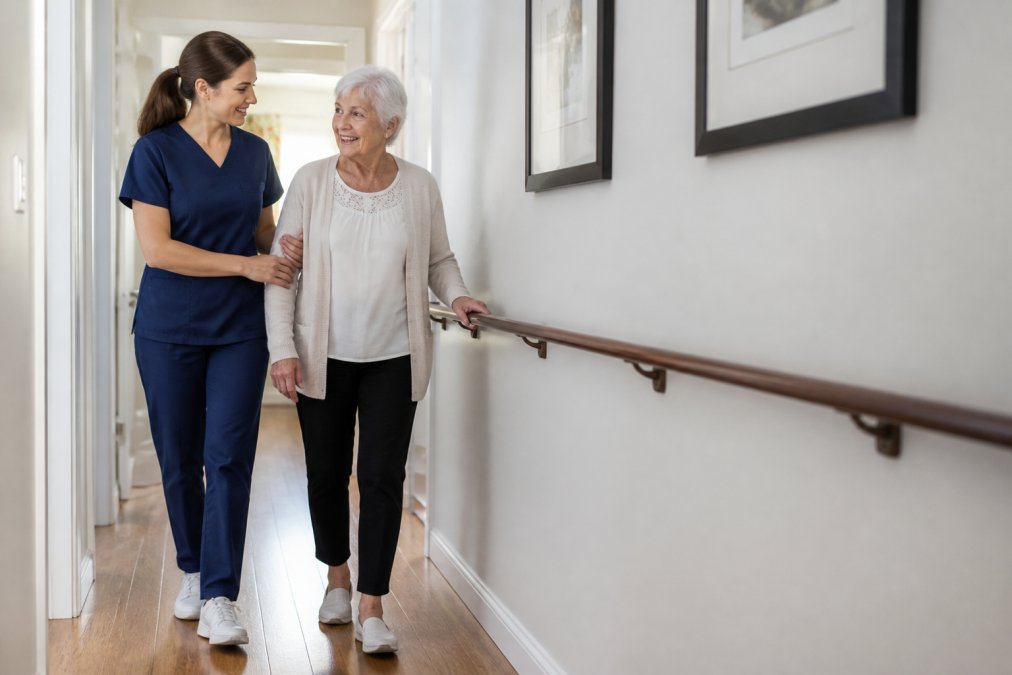
Falls are the leading reason families seek elderly home care, and most are preventable. The fix is rarely one big purchase, it's a room-by-room sweep based on how your parent actually moves.
Understanding Why Falls Happen
Before moving furniture, know what you're preventing. Most falls come from one of four sources:
- Environmental hazards, loose rugs, cluttered walkways, poor lighting, wet floors
- Physical changes, reduced balance, lower-body weakness, vision changes, foot pain
- Medication effects, dizziness or low blood pressure from certain prescriptions, especially when standing up
- Behavioral factors, rushing to the bathroom at night, reaching for items without support, wearing loose slippers
Identifying Fall Hazards Room by Room
Walk through the home at your parent's eye level, not yours, and work through each space.
| Room | Common Hazard | Practical Fix |
|---|---|---|
| Bathroom | Slippery tub, no grab bar | Non-slip mat inside and outside the tub, wall-mounted grab bars at toilet and shower, raised toilet seat |
| Bedroom | Loose rug, low bed height | Remove rugs or secure with double-sided tape, add a bed rail, keep a lamp within arm's reach of the bed |
| Kitchen | Items stored too high or too low | Move daily dishes and food to waist height, use a sturdy step stool with a handrail only if balance is good |
| Hallway | Poor lighting, no rail | Plug-in night lights along the route to the bathroom, continuous handrail on at least one side |
| Stairs | Worn treads, no contrast, single rail | Contrast tape on the top and bottom steps, secure or replace carpet, add a second handrail if possible |
| Entryway | Thresholds, slippery tile, no place to sit | Remove or ramp thresholds, non-slip mats, a sturdy chair by the door for putting on shoes |
Building a Nighttime Bathroom Route
Most falls happen at night, on the way to the bathroom, the highest-value route to fix.
Using Caregiver Monitoring and Alert Systems
Monitoring technology helps families who can't be present every hour. A caregiver alert system with a pull-string sensor pad monitor notifies you the moment your relative tries to stand unassisted.

Practicing Strength and Balance at Home
Environmental fixes only go so far. Balance and leg strength are the other half of fall prevention, and they improve with practice.
What to Do After a Near-Miss
If your parent stumbles but doesn't fall, treat it as a warning. Write down where, when, and what they were doing, then look for the pattern. A near-miss in the same spot twice usually means a hazard you missed or a physical change worth a doctor's visit.
Essential Home Safety Modifications for Seniors
Home modification means changing a house to fit the person living in it. Grab bars, ramps, raised toilet seats, and better lighting are the usual starting points.
Daily Living Aids for Independent Seniors
Daily living aids for independent seniors range from simple grip tools to mobility devices. The right aid preserves dignity by making a task possible again.
Consider these categories:
Smart Caregiver TL-3100V Dual →
- Mobility: A lightweight 4-wheel rollator with a padded seat for outings; a cane with a wide base for indoor use
- Bathroom: A shower chair, a long-handled sponge, a raised toilet seat
- Kitchen: Jar openers, easy-grip utensils, a rolling cart for transferring meals
- Dressing: A sock aid, a long-handled shoehorn, elastic laces
Caregiver Stress Management Techniques That Work
Caregiver burnout is exhaustion that builds when caregiving crowds out rest, work, and relationships. It shows up as irritability, sleep problems, resentment, and a sense of being trapped, most long-term caregivers experience some version of it. The goal isn't to avoid stress, but to build relief into the routine before stress turns into collapse.
Recognizing the Warning Signs Early
Burnout rarely arrives all at once. Watch for these signals:
- Dreading the phone ringing or the door opening
- Snapping at your parent over small things, then feeling guilty
- Skipping your own medical appointments and meals
- Sleeping poorly even when you have the chance to rest
- Feeling like nothing you do is enough
What Actually Helps
-
Scheduled respite, not spontaneous breaks. Respite care is short-term care that covers your relative so you can step away, a few hours at a time or a few days. It works best on the calendar, not when you finally break down. Predictable weekly hours, through an adult day program, a paid home care agency, a volunteer respite program, or a rotating family schedule, prevent the slow accumulation that leads to collapse. If family can't cover it, agencies can send an aide for a set block of hours, and some costs may be offset through long-term care insurance, Medicaid waiver programs, VA benefits, or your local Area Agency on Aging.
Pro Tip Not sure where to start with respite care? The EnhDme team can walk you through your options. Call 888-364-3630 or email valerie@enhdme.com. -
Support groups, in person or online. Peer groups reduce isolation and normalize your frustration. Hospitals, senior centers, and national caregiver organizations run free groups, and online communities fill the gap for caregivers who can't leave the house. Hearing another caregiver describe the exact thing you're ashamed to admit is often the moment things shift.
-
One hard boundary. Pick a non-negotiable weekly commitment that's yours alone, a class, a walk with a friend, a standing call. Treat it like a medical appointment. Vague boundaries get cancelled; scheduled ones get kept.
-
Professional help. A therapist familiar with caregiving can help you separate grief from fatigue. Many caregivers mourn the parent they used to have while caring for the parent they have now.
-
Practical delegation. Write down every task you do in a week, then mark which ones someone else could do. Grocery delivery, prescription pickup, lawn care, and laundry are easiest to hand off. Ask a specific person for a specific task, "Can you take Mom to her Thursday appointment?" works far better than "I need help."
When You're Also Working a Job
Balancing caregiving with employment adds a layer most guides skip. Check whether your workplace offers flexible hours, remote days, or paid family leave beyond what the law requires. Many employers offer caregiver support through an employee assistance program, free counseling, referral services, and sometimes subsidized backup care. Ask HR; these benefits are often underused because no one knows they exist.
Building a Backup Plan Before You Need It
Every caregiver needs a plan for the day they get sick. Identify two people who could step in on short notice, and make sure they know your parent's routine, medication schedule, and emergency contacts. Keep a written care summary, medications, doctors, allergies, daily routine, in a shared folder or on the refrigerator, so the plan explains for you when you can't.
Navigating Legal Rights and Workplace Accommodations
Two legal areas trip up working caregivers: employment protections and caregiving authority.
Planning Post-Hospital Discharge Transitions
Discharge planning is where recoveries succeed or unravel. Hospitals push for quick exits, and unprepared families end up improvising at the worst moment.
Start before discharge. Ask the discharge planner these questions:
- What care tasks will be needed at home, and who will perform them?
- What equipment is required, and can it be in place before arrival?
- Which follow-up appointments are already scheduled?
- What warning signs mean we should call for help?
Frequently Asked Questions
What is the 40/70 rule for aging and caregiving?
The 40/70 rule is a conversation guideline suggesting that when a parent is 70 or older and an adult child is 40 or older, it is time to discuss care preferences and plans. It is not a legal threshold, but a practical prompt. Starting these talks early, before a crisis, gives families time to explore options like home modifications, daily living aids, and care coordination without pressure.
What are three signs of caregiver stress?
Three common signs of caregiver stress are feeling constantly overwhelmed or irritable, withdrawing from friends and activities you once enjoyed, and noticing changes in sleep or appetite. Physical symptoms like headaches or fatigue can also appear. If these persist, consider respite care, a caregiver support group, or speaking with a healthcare professional. Addressing stress early helps you provide consistent, compassionate care.
How can I make my home safer for an elderly relative?
Start with a home safety audit: remove loose rugs, add grab bars in the bathroom, improve lighting in hallways and stairways, and secure cords. Install a caregiver monitoring system, such as a chair pad monitor or door alert, for added peace of mind. For personalized recommendations, explore the EnhDme store collection pages, which offer daily living aids and safety essentials designed for aging in place.
What daily living essentials are most important for home-based senior care?
Prioritize mobility aids like walkers or canes, bathroom safety items such as shower chairs and raised toilet seats, and medication organizers. A caregiver alert pager can also be valuable. These tools support activities of daily living (ADLs) and instrumental activities of daily living (IADLs), helping seniors maintain independence while giving family caregivers confidence.
Leave a comment