

How to Install Handrails on Drywall Safely
A Rail They Can Trust
A handrail only matters in the second someone grabs it hard. That's why what sits behind the drywall decides whether the rail holds. Here's how to find the framing, add backing where there isn't any, and test the rail before your loved one leans on it.
More than a million people a year are treated in U.S. emergency rooms for injuries on stairs, and adults over 60 have the highest injury rate of any age group. A sturdy handrail is one of the simplest supports you can add. But a rail held only by drywall can give way the moment someone needs it most.
Last Updated: November 9, 2026
You cannot install handrails on drywall alone, because drywall is a finish surface that can crumble under a sudden pull. The rail must reach the wood framing behind the drywall or be backed by blocking you add yourself.
- Wood studs usually sit 16 or 24 inches apart on center, so mark both edges of each stud.
- Confirm every stud finder mark with a small pilot hole before drilling.
- Toggle bolts are the strongest drywall-only option but work only as a supplement, never sole support.
- Surface-mounted blocking fastens to studs on the face of the drywall and is the least invasive route.
- Pull down and outward on the finished rail and look for any bracket movement or paint cracks.
The Short Answer: Drywall Alone Won't Hold a Handrail
No, you cannot install handrails on drywall alone. Drywall is a finish surface, not a structural one.
Here's the part most guides skip: the drywall isn't the problem. The problem is what's behind it.
If your stairs can't take a rail at all, a no-installation option may suit you better. You can explore mobile stairlifts for caregivers and home safety.
of older adults in a 2026 survey who had fallen on their stairs at home named a missing handrail or grab rail as one of the causes. It was a small survey, but the point is plain: a rail that isn't there, or doesn't hold, can't help.
Tools, Materials, and Safety Checklist for Handrail Installation
Gather everything before you start. Half-finished rail jobs are how people get hurt.
Tools
- Stud finder with deep-scan mode
- Cordless drill and driver bits
- 1/8-inch pilot bit and a 3/16-inch bit
- 2-foot level
- Measuring tape and pencil
- A thin nail for confirming stud locations
Materials
- Wall-mounted handrail or grab bar
- Mounting brackets with screws
- 3-inch wood screws or lag screws for studs
- Toggle bolts rated for your rail's load
- 2x6 or 2x8 lumber for blocking, if needed
- Drywall saw, patching compound, and paint for repairs
Safety
- Safety glasses and work gloves
- A helper to hold the rail while you mark
- A sturdy step stool, never a chair
Step 1: Plan Handrail Height and Clearance from Wall
Before you drill anything, decide where the rail goes. Height and clearance decide whether the rail actually helps someone catch a stumble.
Residential codes and accessibility guidance set rail heights, and the exact figure varies by location.
Clearance matters just as much. Leave enough clearance between the wall and the rail so a hand can wrap around it comfortably, and check your local building code for the required dimension.
If your loved one has limited grip, balance, or reach, an occupational therapist can suggest a rail height and placement that fits how they actually move on the stairs.
Measuring Stair Rise and Handrail Slope
Mark the height at the bottom of the stairs and again at the top. Snap a chalk line between the two marks. That line is your handrail slope, and every bracket sits on it. Measure twice here, because a rail that dips or rises mid-run feels wrong the moment you grab it.
Step 2: Find Wall Studs for Handrail Installation into Wall Studs
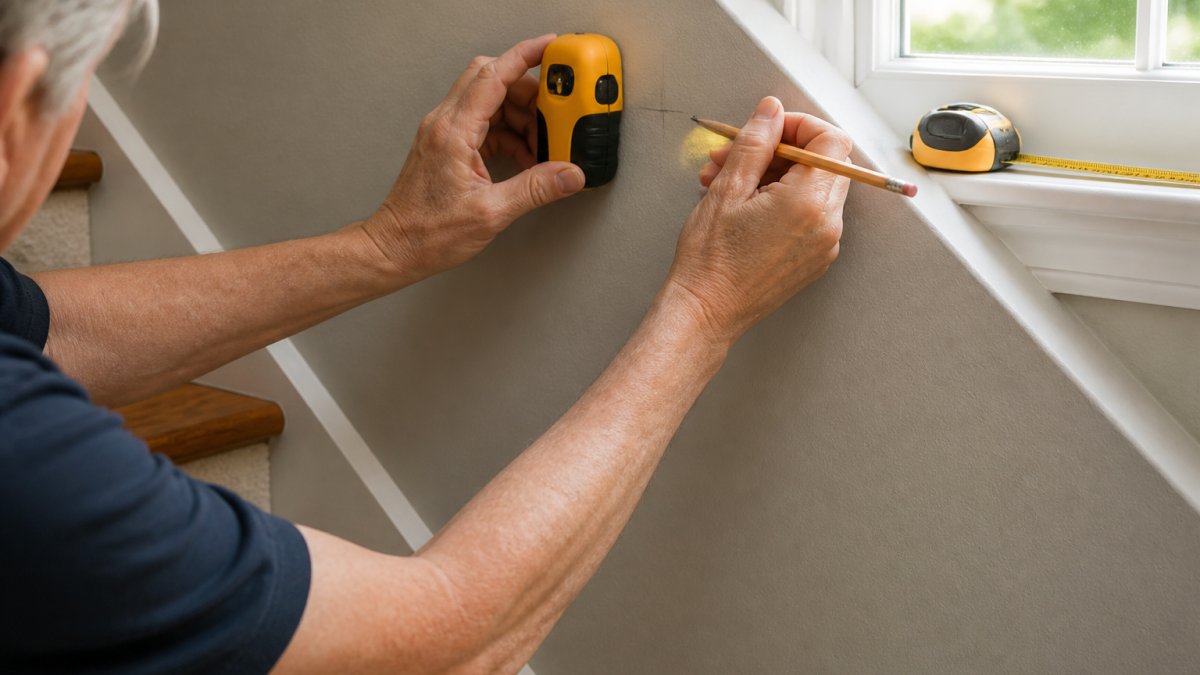
Handrail installation into wall studs is the strongest option, and it starts with finding the framing. Wood studs usually sit 16 or 24 inches apart on center.
Reading a Stud Finder and Confirming with a Pilot Hole
Stud finders can give false readings, especially on walls with pipes or double drywall. Confirm each mark with a small pilot hole through the drywall. If the bit meets solid wood, you've found your stud. If it slides through into empty space, move over an inch and try again.
Step 3: Can Drywall Anchors Hold a Handrail?
Can drywall anchors hold a handrail? Not as the only support, and not for a rail someone will grab during a fall. The reason is mechanical, not a matter of picking a "stronger" anchor.
Here is how the common anchor types actually behave on a stair rail:
-
Plastic expansion anchors and self-drilling anchors
Made for pictures, shelving, and light fixtures. They are not appropriate for a load-bearing handrail.
-
Molly bolts (hollow-wall anchors)
Spread inside the cavity and hold better than plastic, but they still bear on drywall, not framing. Treat them as unsuitable for a stair rail that must catch a fall.
-
Toggle bolts
The strongest drywall-only option because the bar spreads the load across a wider patch of wall. Even so, a toggle bolt bears on the back of the drywall, and drywall can fail in a hard grab. Use toggle bolts only as a supplement when a bracket cannot reach framing, and never as the sole support for a stair handrail.
-
Lag screws or structural screws into wood framing or solid blocking
The only fasteners that transfer the load into structure. This is the standard to aim for.
A useful rule of thumb: if you would not hang a heavy shelf or a child's swing from it, do not hang a handrail from it.
Do not let a rail that "feels solid" when you tug it convince you that anchors are enough. A slow pull is not the same as a sudden fall load. The failure usually shows up the first time someone actually needs the rail.
If a bracket lands between studs and you cannot add blocking, the safe answer is to relocate the bracket to the nearest stud or extend the blocking, not to substitute a bigger anchor. The next section covers the blocking route.
Here is how the common anchor types behave when used on a stair rail.
| Anchor type | Holds how | Verdict for a handrail |
|---|---|---|
| Plastic expansion and self-drilling anchors | Grip the thin drywall layer | Not appropriate for a load-bearing handrail |
| Molly bolts (hollow-wall anchors) | Spread inside the cavity, bear on drywall | Unsuitable for a stair rail that must catch a fall |
| Toggle bolts | Bar spreads load across a wider patch | Strongest drywall-only option, supplement only, never sole support |
| Lag or structural screws into framing or blocking | Transfer the load into structure | The standard to aim for |
A slow tug isn't a fall. A handrail has to hold on the one day someone grabs it with their whole weight.

From EnhDme
Step 4: Handrail Installation Without Studs Using Blocking
Handrail installation without studs means adding backing the rail can trust. Blocking is a length of lumber fastened to the studs behind the drywall, giving the brackets a solid surface to bite into even where no stud lines up with a bracket.
Choose the blocking
A 2x6 or 2x8 is common because it gives you room to shift a bracket an inch or two without losing the wood. Run it horizontally at rail height, long enough to span at least two studs so the blocking itself is anchored to structure.
Two ways to add it
- Surface-mounted blocking (easiest). Fasten the board to the studs on the face of the drywall with structural screws long enough to reach the framing, then mount the brackets to the board. This leaves a visible board, which some people finish or paint to match the wall. It is the least invasive route and the one most caregivers can do without opening the wall.
- In-wall blocking (cleanest look). Cut an opening in the drywall at rail height, fasten the blocking to the studs inside the cavity, then patch and paint. This hides the backing but means drywall repair. Only take this route if you are comfortable patching, or plan to have it patched.
A decision tree for the three wall situations
-
Stud where the bracket lands
Fasten directly into the stud with lag screws or structural screws. No blocking needed.
-
No stud at the bracket, but wall access is easy
Add surface-mounted blocking across the studs and mount to it.
-
No stud and you want a clean wall
Add in-wall blocking and repair the drywall, or relocate the bracket to the nearest stud if the rail design allows.
-
No stud and no willingness to add blocking
Do not install a load-bearing stair rail on anchors alone. Choose a different mounting location or a different rail design.
Troubleshooting the common problems
- Missed the stud with a pilot hole: move over about an inch and try again. Do not enlarge the hole hoping to find wood; you will only weaken the drywall.
- Bracket sits proud of an uneven wall: a continuous board gives every bracket a flat plane, which is why blocking also helps on wavy walls.
- Old damage or a loose bracket already there: remove the old fastener, add blocking that spans the damaged area, and mount fresh. Do not reuse a hole that has already torn out.
- Drywall crumbled around an anchor: cut back the loose paper and gypsum, add blocking behind the area, patch the surface, and remount into the blocking.
Measure the rail's bracket spacing before you cut blocking. A board that spans two studs and covers every bracket location saves a second trip to the hardware store.
Blocking is not a shortcut around the drywall problem. It is the way to turn a drywall wall into a surface a handrail can safely use.
Step 5: Mount the Brackets, Attach the Rail, and Test Stability
Mounting comes down to three moves: mark, drill, and drive.
- Hold each bracket against the wall on your chalk line and mark the screw holes with a pencil.
- Drill pilot holes at each mark, sized to your fasteners.
- Drive the screws through the bracket into the stud or blocking.
- Set the rail into the brackets and tighten the bracket screws.
- Check the rail with a level, then test it.
For the stability test, grab the rail and pull down and outward with steady pressure. Look for any movement at the brackets or cracks in the paint around them. A rail that shifts even slightly needs longer fasteners or added blocking before anyone uses those stairs.
If you are unsure what's inside the wall, find pipes or wiring where the rail needs to go, or the rail still moves after reinforcing, stop and bring in a licensed contractor or handyman before anyone relies on it.
Choosing a Grab Bar and Getting Help from EnhDme
Picking the rail is easier once the wall question is settled. Match the length to the run: short bars suit a single step or a doorway transition, and longer bars suit a few steps or a landing. A full flight of stairs needs a continuous handrail that runs its whole length.
EnhDme offers wall-mounted grab bars, including a white steel wall mount grab bar for bathroom use, an 18-inch wall grab bar for shorter runs, and a 32-inch knurled steel grab bar for a longer, textured grip. Follow each product's installation instructions for mounting.
Wall-Mounted Grab Bars


Drywall will not hold a handrail, but the framing behind it will, and finding that framing takes less time than most people expect. If you're setting up a home for an aging parent, start with the stairs, then work through the bathroom. EnhDme was founded by caregivers, and we stock grab bars and safety rails from trusted manufacturers so families can make these fixes without guesswork. Get started with EnhDme and give your loved one a rail they can actually trust.
Frequently Asked Questions
Can drywall anchors hold a handrail?
Standard drywall anchors are not designed to hold a handrail under a person's full body weight and should not be used as the only support. A handrail must attach to wood studs or to solid blocking installed behind the drywall. If a bracket location has no stud, add blocking or reposition the bracket so at least one fastener hits framing. Test every finished rail with a firm pull before use.
How far does a handrail need to be from the wall?
Handrail clearance from the wall should allow fingers to wrap around the rail comfortably; check your local building code for the required dimension. Bracket style affects this: some brackets set the rail closer, others hold it farther out. Check the bracket manufacturer's instructions and your local building code, since requirements can vary. Measure clearance at several points along the rail to confirm it is consistent.
How do you install a handrail when there are no studs where the brackets need to go?
When no stud lines up with a bracket, you have two safe options. First, cut a small opening in the drywall and install wood blocking between the studs, then patch and mount the bracket to the blocking. Second, shift the bracket location slightly to land on a stud. Avoid relying on drywall anchors alone for a rail that will carry weight. A stud finder and a pilot hole confirm what is behind the wall.
How can you tell if a handrail is securely installed?
After installation, grip the rail and pull firmly toward you and downward at several points along its length. The rail should not flex, move, or make cracking sounds at the wall. Check that every screw is tight and that brackets sit flush. If you feel any movement, stop and reinforce the mounting, usually by adding blocking or moving fasteners into studs. A stable rail is the goal before anyone uses the stairs.

Shop Grab Bars
Start with a 32-inch knurled steel bar for a longer, textured grip on short runs and landings.
Shop NowFamily Caregiver Resources
Guidance, tools, and support from EnhDme to help you care safely and take a real break.
Explore Resources
For more than 25 years, Valerie has seen home care from every side of the front door. She built and led a home care agency, cared for her own parents, and has long championed older adults and the families who love them. Today she brings that hard-won perspective to EnhDme, helping caregivers find the equipment and supplies that make home a safer, gentler place to give and receive care.
Sources
Stair-related injuries treated in United States emergency departments (2018). American Journal of Emergency Medicine.
Centers for Disease Control and Prevention (2020). Older Adult Falls Reported by State.
National Center for Health Statistics (2025). Unintentional Fall Deaths in Adults Age 65 and Older: United States, 2023. NCHS Data Brief No. 532.
Foster R, Akpan A, Hodges M, et al. (2026). Why do older adults fall on stairs at home? Insights from a nationwide survey of 194 older adults. British Geriatrics Society.
Leave a comment