

How Do You Measure a Home Hospital Bed Mattress?
The Opening That Matters: Getting the Mattress Right the First Time
When a hospital bed comes home, the mattress is often the part that gets replaced first. Ordering one sounds simple until you're standing over the frame with a tape measure, wondering which edge to hook it on. Here's exactly where the tape goes, how to check the fit, and what to do when the bed's label is long gone.
Between 1985 and 2013, the FDA received 901 reports of people caught or trapped in hospital beds, and 531 of them died. Many of those events happened in the gaps between a mattress and the rails or the headboard, and some happened in private homes. A mattress that fits the frame is one of the simplest ways to help close those gaps. It starts with a tape measure and ten careful minutes.
Last Updated: November 2, 2026
To measure for a home hospital bed mattress, measure the inside opening of your bed frame: hook the tape on the inside face of the footboard to the inside face of the headboard for length, then measure inside face to inside face of the side rails at three points and use the smallest width reading. Order a hospital bed mattress that matches those frame opening numbers, not the bed's overall outside dimensions.
- The most common hospital bed mattress is 36 inches wide and 80 inches long.
- Measure width at the head, middle, and foot, then use the smallest reading.
- Repeat each measurement once and re-check if readings differ by more than half an inch.
- After delivery, slide your hand along each side rail to confirm no gap remains.
- Never fill a gap between the mattress and rail with pillows or rolled blankets.
Why an Accurate Measurement Matters Before You Buy
Measuring for a home hospital bed mattress comes down to one number: the inside opening of your bed frame. A mattress that is too long will buckle at the head or foot. One that is too short or too narrow leaves gaps.
Below, we walk through exactly where to put the tape, how to check clearance, and what to do when the bed's model plate is long gone. The payoff is simple: one mattress, delivered once, that drops in cleanly and stays put.
Hospital Bed Mattress Dimensions You'll Commonly See
Most home hospital bed mattresses sold today fall into a small set of standard sizes. Knowing the typical numbers gives you a starting point before you ever pick up a tape measure.
The most common hospital bed mattress is 36 inches wide and 80 inches long. You will also see 75-inch and 84-inch lengths, and narrower 32- to 35-inch widths on some frames.
Standard, Narrow, and Bariatric Sizes
Here is how the main categories break down:
-
Standard
About 36 inches wide by 80 inches long.
-
Narrow
Roughly 32 to 35 inches wide, often used where floor space is tight.
-
Bariatric or heavy-duty
Wider decks, commonly 42 to 48 inches, sometimes up to 60 inches.
Bariatric beds are built for heavier users and typically have wider decks. A standard mattress will not fit a wider bariatric deck, so match the mattress to the frame you measured.
How to Measure a Hospital Bed Frame Step by Step
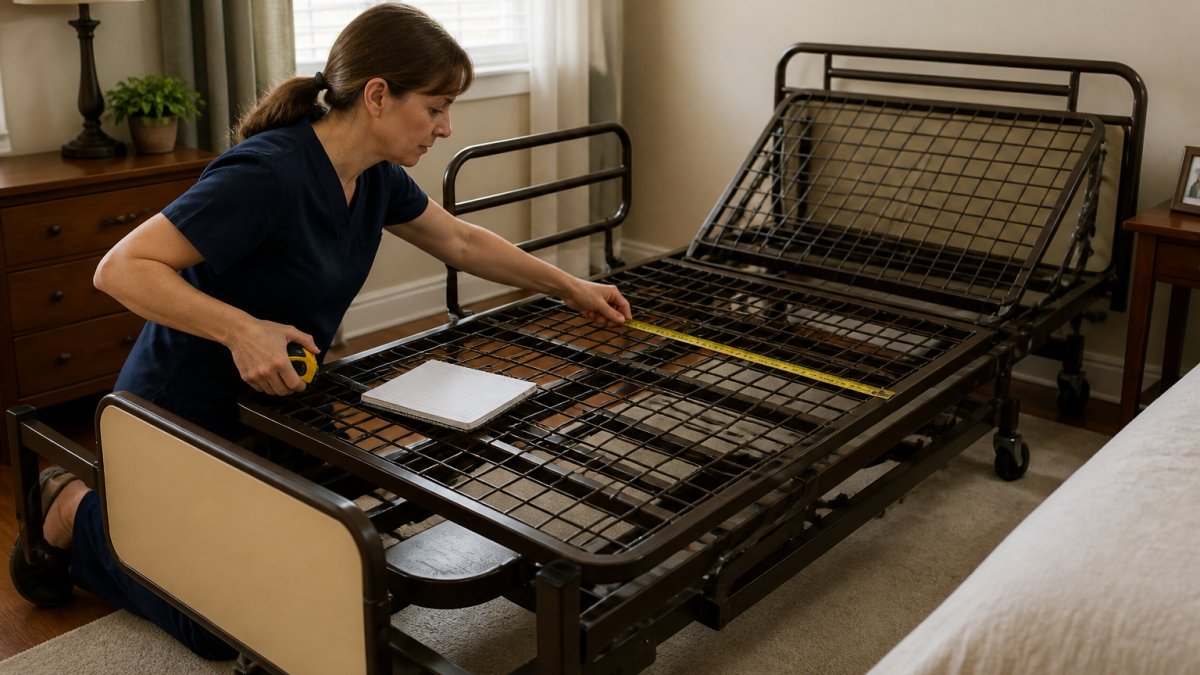
Measure the inside of the frame, not the outside. That single rule prevents most ordering mistakes.
Before You Start
- Remove the old mattress so the deck and rails are fully visible.
- Lower the bed to its flat, lowest position and lock the wheels.
- Have a second person hold the far end of the tape if the frame is longer than your reach; a sagging tape reads short.
Where to Place the Tape
- LengthHook the tape on the inside face of the footboard and run it straight to the inside face of the headboard. Read the number where the tape meets the inside panel, not the outer edge. On many home beds the headboard and footboard panels are thicker than they look from outside, so an outside measurement can be off by several inches.
- WidthMeasure between the inside faces of the side rails at three points, near the head, at the middle, and near the foot. Frames can bow slightly; use the smallest of the three readings as your working width.
- Deck surfaceLook for raised bars, cross-braces, or gaps in the deck. Note any spot where the mattress would bridge rather than rest flat.
- Deck heightMeasure from the floor to the top of the deck. Add your intended mattress thickness to see where the sleep surface will sit relative to the floor.
- Write both numbers downRecord them in inches, and note the bed model if you can find it on a label under the deck, on the back of the headboard, or on the frame legs.
- Repeat each measurementMeasure everything once more. If the two readings differ by more than half an inch, re-level the tape and try again.
Measuring an Articulated Frame
If the bed is articulated, measure it flat first. Then raise the head and foot sections and measure again at the hinge points to see whether the frame pinches or shortens the mattress space. A mattress that fits flat can still bind when the head section elevates if the deck geometry changes the usable length.
Photograph the tape at each reading with your phone. If a measurement is questioned later, the photo settles it without another trip to the bedroom.
Frame Openings Versus Overall Bed Dimensions
Two different numbers get confused constantly. The overall dimensions describe the whole bed, including headboard, footboard, and side rails. The frame opening is the clear space the mattress drops into.
Only the frame opening matters for mattress fit. Overall dimensions matter for a different reason: making sure the bed fits in the room and leaves space to move around it.
| What You Measure | Where the Tape Goes | What It Tells You |
|---|---|---|
| Frame opening length | Inside footboard to inside headboard | Mattress length to order |
| Frame opening width | Inside face to inside face of side rails, at three points | Mattress width to order |
| Deck height | Floor to top of deck | Mattress thickness that keeps the bed at a safe height |
| Overall bed size | Outer edges of the whole frame | Whether the bed fits the room |
The mattress doesn't care what the bed measures on the outside. It only cares about the opening it drops into.
A Simple Record Sheet
Copy these lines onto a notepad or your phone before you shop:
- Frame opening length: ______ inches
- Frame opening width (smallest of three): ______ inches
- Deck height: ______ inches
Bring that sheet to your supplier. It answers most of the questions a sales team will ask and reduces the chance of an ordering error.
Hospital Bed Mattress Thickness and What It Changes
Mattress thickness affects how the mattress sits in the frame and where the sleep surface sits relative to the floor.
Home care mattress thickness varies by model, so check the listing for the exact height. A thicker mattress raises the sleep surface.
Thickness also changes how side rails and the frame interact with the mattress. A mattress that sits too high can leave a gap under the rails, which is a genuine entrapment risk.
Span America Geo-Mattress HC Home Care Foam Mattress

For a closer look at how a 5-inch home care foam mattress is built and what lengths it comes in, you can browse the Span America Geo-Mattress HC foam mattress and compare its 75, 80, and 84-inch options against your measurements.
View the MattressHospital Bed Mattress Compatibility: Will It Fit Safely?
A mattress fits well when it fills the frame opening with no large gaps at the head, foot, or sides, and when its weight capacity covers the user. The checklist below turns that general statement into specific checks you can run before you order and again after delivery.
potential entrapment zones in a hospital bed system are ones where a mattress of the right length, width and depth helps reduce the openings: the spaces under and beside the rails, at the rail ends, and between the mattress and the headboard or footboard.
The Fit Checklist
- Length: within about an inch of the inside headboard-to-footboard measurement. A mattress that is too long will buckle at the head or foot; one that is too short leaves a gap at one end.
- Width: snug between the side rails, with no gap wide enough to trap a limb. Use the smallest of your three width readings as the target.
- Weight capacity: rated above the user's weight, with room to spare. Check the label on the mattress, not just the frame rating.
How to Verify Clearances After Delivery
- Place the new mattress on the deck without sheets.
- Press down at each corner and along the middle to confirm it rests on the deck, not on a raised bar.
- Slide your hand along each side rail. If your fingers fit easily into a gap between the mattress edge and the rail, the fit is too loose.
- Check the head and foot ends the same way.
- Raise and lower the head section if the bed articulates, and re-check the side gaps at the hinge.
Never fill a gap between the mattress and the rail with pillows or rolled blankets. If the fit leaves a gap, the mattress is the wrong size for that frame.
What to Do If the Fit Is Off
- Too long or too wide: stop using the mattress on that frame and contact the supplier about a size exchange.
- Too short or too narrow: the same applies; a loose mattress can shift under a user who cannot reposition themselves.
- Correct footprint but wrong height: a thinner or thicker mattress may solve a rail-clearance problem, but confirm with the frame maker that the new thickness is approved.
Matching Support Type to the User
Fit is only half the decision. The support surface should match how the person spends their time in bed.
- Foam mattresses can be rotated head to foot for even wear.
- Innerspring options may feel firmer to some sleepers.
If your loved one spends most of the day in bed, has fragile skin, or has trouble shifting position, ask their doctor, nurse, or occupational therapist which support surface they recommend before you order.
When the Numbers Do Not Match Any Standard Size
Some frames are built to unusual dimensions. If your frame opening falls outside the standard, narrow, and bariatric ranges, a replacement mattress built for a specific bed frame may be the safer route than forcing a standard size. You can see the Journey Upbed replacement memory foam mattress series as an example of a mattress made to match a particular frame rather than a generic size.
When the Bed Model or Specifications Are Unknown
No model plate? No manual? That happens more often than you would think, especially with beds passed down through a family.
Start with the tape measure, since the frame opening is the real answer regardless of the model name. Then try these:
- Look for a label under the deck, on the back of the headboard, or on the frame legs
- Search the frame's stamped numbers or serial plate online
- Measure the frame opening and match it to standard sizes
If the frame turns out to be an unusual size, check the listing dimensions of any replacement mattress against your measurements before ordering.
Choosing Your Replacement Mattress at EnhDme
Once you have your two numbers written down, the rest is straightforward. Match the frame opening, confirm the weight capacity, and pick the support type that suits the person using the bed.
A few practical notes from our team:
- Foam mattresses can be rotated head to foot for even wear
- Innerspring options may feel firmer to some sleepers
- Always confirm the length fills the deck, with no big gaps at either end
When you are ready to compare options side by side, you can shop the bariatric mattress collection and filter by the size you measured.
Getting the measurement right is the difference between a mattress that drops in cleanly and one that has to go back.
Frequently Asked Questions
Are hospital bed mattresses a standard size?
Most home care mattresses follow a common footprint of about 36 inches wide and 80 inches long, but that is a convention rather than a guarantee. You will also find 35-inch widths and lengths of 75 or 84 inches, plus narrow and heavy-duty sizes. Because of that variation, measure your own bed deck rather than assuming a standard size will drop in. Write down the inside width, the inside length, and the deck height before you shop.
How do you check whether a mattress will fit a hospital bed?
Compare your recorded inside measurements with the mattress dimensions on the listing, and aim for a snug fit that sits inside the frame opening without being forced. Check hospital bed mattress compatibility in both directions: the mattress should not overhang the deck, and it should not leave openings wide enough for a limb or a rail to trap. Confirm the weight capacity covers the person using it, and confirm the thickness still lets side rails lock securely.
What should you measure besides mattress length and width?
Measure the deck height from the floor, the distance between the side rail mounting points, and the clearance under the frame if the bed is adjustable. Note the thickness of your current mattress so a replacement does not change how the rails sit. Also record the room clearance around the bed for a walker or wheelchair. These numbers decide whether a mattress works in practice, not just whether it fits the rectangle.
How much clearance should there be around a hospital bed mattress?
Aim for a snug but not forced fit, with the mattress sitting inside the frame opening and no more than a small gap at the head and foot. Large gaps let the mattress shift during transfers, and an overhanging mattress can put strain on the deck. Around the bed itself, keep enough floor space for a walker or wheelchair to turn safely. If you are unsure, measure twice and ask before ordering.
Shop Bariatric Mattresses
Compare mattress sizes, weight capacities and support types against the numbers on your record sheet.
Shop NowFamily Caregiver Resources
Guidance, tools, and support from EnhDme to help you set up a safer bed and a gentler routine at home.
Explore Resources
For more than 25 years, Valerie has seen home care from every side of the front door. She built and led a home care agency, cared for her own parents, and has long championed older adults and the families who love them. Today she brings that hard-won perspective to EnhDme, helping caregivers find the equipment and supplies that make home a safer, gentler place to give and receive care.
Sources
U.S. Food and Drug Administration. Hospital Beds (entrapment reports, 1985–2013).
Hospital Bed Safety Workgroup / U.S. FDA (2006). A Guide for Modifying Bed Systems and Using Accessories to Reduce the Risk of Entrapment.
AARP & National Alliance for Caregiving (2025). Caregiving in the US 2025.
Leave a comment