

Durable Medical Equipment for Home Care: 2026 Guide
Table of Contents
- What Counts as Durable Medical Equipment for Home Care
- Mobility Aids for Seniors: Rollators, Walkers, and Transfer Support
- Bathroom Safety Equipment: Preventing Falls in the Highest-Risk Room
- Daily Living Aids for Elderly Adults: Beds, Tables, and Bedside Support
- Home Safety Assessment Checklist for Caregivers
- Renting vs. Buying Durable Medical Equipment for Home Care
- Caregiver Ergonomics: Protecting the Person Doing the Lifting
- Frequently Asked Questions
Last Updated: September 28, 2026
What Counts as Durable Medical Equipment for Home Care
Durable medical equipment for home care is any reusable device or aid that helps someone manage daily life safely at home, mobility aids, bathroom safety gear, support surfaces, and daily living tools.
- Durability. The item is built to survive years of daily use, not months.
- Medical purpose. It supports a health need, like mobility, pressure relief, or fall prevention.
- Reusability. It isn't consumed or disposable. You clean it, maintain it, and keep it.
Mobility Aids for Seniors: Rollators, Walkers, and Transfer Support
Mobility aids are the most common starting point for families, and the most commonly bought wrong. A device that's too heavy, too wide, or too tall gets abandoned within a month.
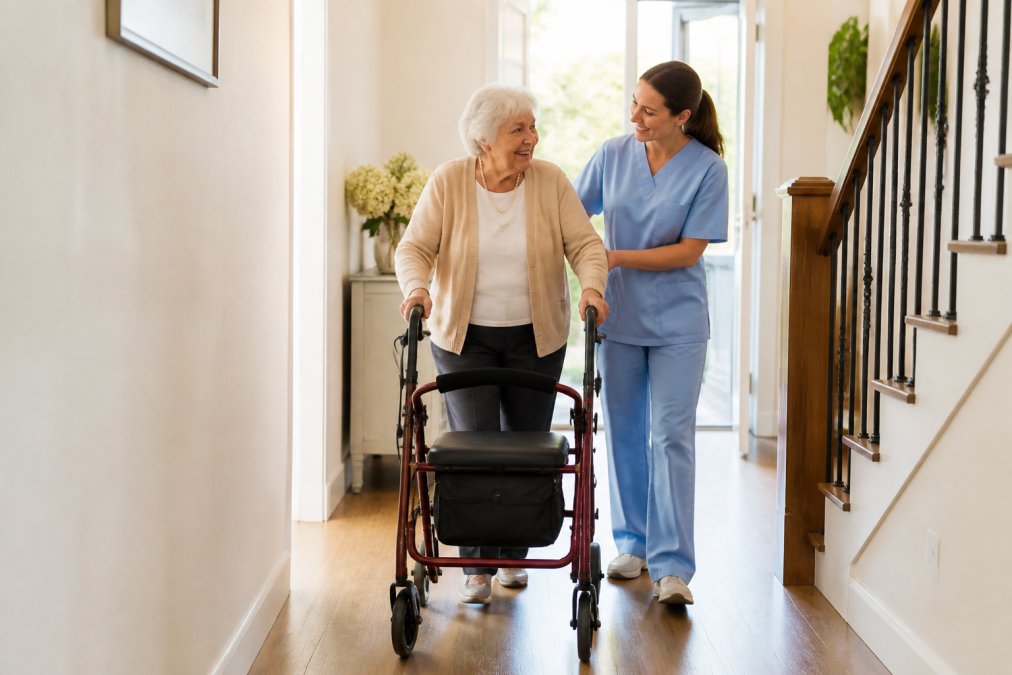
Rollators and Walkers: Matching the Aid to the Person
A walker suits someone who needs steady, two-handed support and doesn't tire easily. It's light and folds flat, but offers no place to sit, so longer trips become exhausting.
A quick way to sort the categories:
- Standard walker (no wheels). Maximum stability, slowest pace. Best for early recovery or very unsteady balance over short indoor distances.
- Two-wheel walker. The front legs glide, the rear legs grip. A good middle ground for someone who can lift the frame but needs to lean.
- Rollator (three or four wheels). Continuous rolling with hand brakes and a seat. Best for someone who walks distances and needs to rest.
- Transport chair or wheelchair. For someone who cannot safely walk even with support. This is a seated-transfer decision, not a walking decision.
How to Measure and Fit a Walker or Rollator
This is the step most families skip, and the reason aids get returned. You can do it all at home with a tape measure and a doorway.
Brakes, Grips, and the Details That Decide Whether It Gets Used
Locking hand brakes are essential for anyone who needs to stop and rest, a rollator that rolls away while the user sits down is a fall waiting to happen. Test the brake levers with the person's actual hand strength; some designs require a firm squeeze that arthritic hands can't manage.
Patient Lifts and Transfer Support
When a person can no longer bear weight safely, a lift replaces the caregiver's back, the single most important piece of equipment for preventing caregiver injury.
- Full-body lift. For transfers between bed, chair, and floor when the person can bear little or no weight.
- Sit-to-stand lift. For someone who can bear some weight and just needs help rising. It's smaller and faster for bathroom and chair transfers.
- Transfer board. A low-cost, low-tech option for seated transfers when the person can help and the surfaces are level.
Bathroom Safety Equipment: Preventing Falls in the Highest-Risk Room
The bathroom is where falls happen most, and where the fixes are cheapest. Wet tile, tight space, and a standing transfer combine into the worst possible setup.
Shower Chairs and Commode Chairs
A basic shower stool works for someone with good balance who can't stand long. A shower commode chair is better when transfers are the real problem.

Daily Living Aids for Elderly Adults: Beds, Tables, and Bedside Support
Daily living aids keep a person independent in the small moments: getting out of bed, eating a meal, reaching for water at night. These are the purchases families delay longest, and regret most.
Homecare Beds and Support Surfaces
A homecare bed turns a bedroom into a care space without the institutional feel. A semi-electric bed motorizes the head and knee sections while frame height adjusts with a manual crank, keeping it reliable and preventing accidental drops.
B120C Semi-Electric Homecare Bed →

Bedside Accessories and Fall Prevention
Three small items change the overnight experience more than any single purchase:
- A bed assist handle gives a stable grip for sitting up and standing. Look for a multi-grip design that matches the hand's natural path.
- A tri-fold bedside floor mat cushions the impact if a fall happens anyway. High-density foam and a non-skid base are the two features that count.
- An overbed table keeps meals, medications, and devices within reach, with a spill edge and easy-clean top.
Home Safety Assessment Checklist for Caregivers
A home safety assessment is a room-by-room walkthrough that finds fall risks before they cause a fall. Do it once when care starts, then repeat every few months:
- Clear every walking path of cords, rugs, and clutter
- Test lighting in hallways, stairs, and the bathroom
- Confirm the bed height lets the person's feet touch the floor when seated
- Check that the bathroom has a stable chair and a secure grab point
- Verify mobility aid width clears every doorway on the route
- Place a floor mat beside the bed if rolling out is a risk
- Keep a phone or call button within arm's reach of the bed and chair
- Re-check weight capacity on every device as needs change
Renting vs. Buying Durable Medical Equipment for Home Care
Buying usually wins for long-term needs; renting makes sense for short recovery windows. The decision comes down to how long the equipment will be used and whether the model may change as needs shift.
| Situation | Better Choice | Why |
|---|---|---|
| Recovery under 3 months | Rent | Avoids paying full price for short use |
| Long-term or permanent need | Buy | Lower cost over time, no return deadline |
| Equipment may change as needs shift | Rent first | Lets you test the fit before committing |
| Multiple users in a household | Buy | Shared across users, no per-use cost |
| High upfront cost, tight budget | Rent | Spreads the cost across months |
| Equipment that touches skin or is hard to sanitize | Buy | You control the cleaning history |
The Real Cost Math
Here's the part most guides miss: a rental that runs long often costs more than buying outright. Rental pricing is usually a recurring monthly charge, and the meter keeps running as long as the equipment sits in the home. If the need will last beyond a few months, buying is usually smarter.
- Delivery and pickup. Rentals often include setup and removal, which is real value for a hospital bed or a lift.
- Maintenance and repairs. A rental company usually services what it owns. When you buy, that responsibility is yours.
- Consumables. Slings, mattress covers, and replacement pads are separate purchases either way.
- Storage after the need ends. A rented item goes back. A purchased item lives in your garage.
When Renting Is Clearly the Right Call
- Short, predictable recovery. A knee replacement or planned surgery has a known timeline. Rent for that window and return it.
- You're testing a fit. Rent for one month, watch how the person uses the item, then buy the version that fits.
- The need is genuinely uncertain. If the care plan is still being figured out, renting buys you information.
- The item is bulky and you have no place to keep it. A hospital bed is a large object to own forever.
When Buying Is Clearly the Right Call
- The need is long-term or permanent. Chronic conditions don't have a return date.
- More than one person will use it. A shared walker or commode chair has no per-use cost when you own it.
- Hygiene matters most. Items that contact skin, bedding, or the bathroom are easier to trust when you control how they're cleaned and by whom.
- You want to customize. Adding a tray, a different sling, or a padded seat is simple on equipment you own and often restricted on a rental.
Questions to Ask Before You Commit
Whichever route you take, get clear answers on these before anything is delivered:
- What's the return process?
- What happens if the item breaks? Is there a service call or a swap?
- Is the item sized to the person, or one-size-fits-all?
Caregiver Ergonomics: Protecting the Person Doing the Lifting
Caregiver ergonomics is the practice of moving and transferring a person without injuring your own back, the topic families ignore until the caregiver gets hurt.
- Use a lift for any transfer the person can't assist with. Manual lifting of dead weight is how backs fail.
- Raise the bed height before you work. A bed at waist height spares your spine during dressing and linen changes.
- Keep the person close to your body. Reaching out to lift multiplies the load on your back.
- Turn your feet, don't twist your torso. Twisting under load is the classic injury mechanism.
- Slide, don't lift, when a transfer board fits the situation.
Frequently Asked Questions
What qualifies as durable medical equipment for home use?
Durable medical equipment for home care generally means items that serve a medical purpose, withstand repeated use, and are not useful to someone who is not ill or injured. Common examples include hospital beds, patient lifts, walkers, commode chairs, and support mattresses. The equipment must be appropriate for use in the home rather than a clinical setting. If you are unsure whether a specific item qualifies, ask the supplier for a product description and check with a healthcare professional about whether it fits your family member's needs.
What are the most important safety features to look for in home care equipment?
Weight capacity is the first thing to verify. Every device has a maximum load rating, and choosing one that matches the user's weight with room to spare matters for stability. Look for non-skid feet or locking casters, adjustable height settings so the fit is correct, and padded contact points for comfort. For beds, check for a backup battery connection and rail options. For bathroom safety equipment, confirm the frame is rustproof and the seat has a hygiene opening if needed. Read the manufacturer's instructions before first use.
How do I determine which mobility aids for seniors are right for my family member?
Start with how much weight the person can bear and how steady their balance is. A rollator with four wheels and hand brakes suits someone who needs a rest seat and walks longer distances. A standard walker works better for someone who needs to lean forward for stability. If the person cannot bear weight at all, a patient lift may be necessary. Ask a physical therapist to observe a transfer and recommend a category. Then check doorway widths and floor surfaces at home before ordering.
What daily living aids for elderly adults are recommended for aging in place?
The most useful daily living aids for elderly adults include a bed assist handle for safe transfers, an overbed table for meals and activities, a bedside commode or commode chair, a shower chair with a padded seat, and a fall safety mat beside the bed. A homecare bed with adjustable head and knee sections helps with comfort and circulation during long periods of rest. These items support independence with everyday tasks and reduce the physical strain on family caregivers.
How often should home medical equipment be inspected for safety?
Check high-use items like walkers, rollators, commode chairs, and bed rails monthly for loose bolts, worn rubber tips, cracked seats, or damaged brakes. For powered equipment such as electric beds and patient lifts, test the motor and hand control weekly and replace backup batteries every 12 months. Wipe down surfaces with a disinfectant that is safe for the material. If any part feels unstable or a mechanism sticks, stop using the device and contact the supplier for replacement parts or service.
Leave a comment